

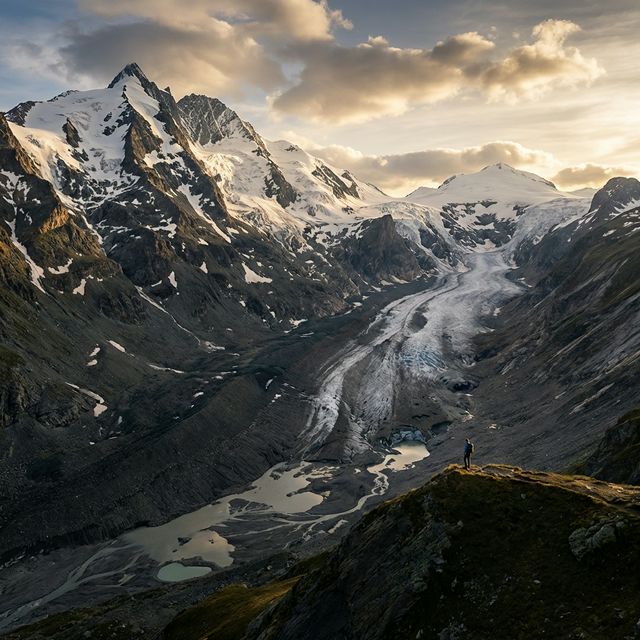
The Alps are warming at twice the global average rate. Over the past 50 years, the mean temperature across Italy’s mountains has risen by approximately 2 degrees C, with concrete consequences for skiing and the entire mountain economy. This is not alarmism: it is the reality with which Italian ski resorts contend every day.
The data: what is happening
Rising temperatures
- The Alps are warming at 0.3 degrees C per decade
- The 0 degree C isotherm (the altitude at which the temperature is 0 degrees) has risen by approximately 400 metres since 1970
- Days with above-zero temperatures in winter at 1,500 m have increased by 30%
Declining snowfall
- The duration of the snow cover at 1,500 m has shortened by approximately 30 days over the past 50 years
- Snowfall below 1,500 m has decreased by 20-30%
- Reliable natural snow is now found above 1,800-2,000 m (it was 1,200-1,500 m in the 1980s)
Glaciers in retreat
Italy’s glaciers are disappearing at an accelerating rate:
- The Marmolada glacier, the largest in the Dolomites, has lost 70% of its surface area since 1900
- Several small Apennine glaciers (such as the Calderone on the Gran Sasso) have already disappeared entirely
- The Presena glacier, where summer skiing takes place, uses geotextile covers over exposed areas to slow melting
The impact on ski resorts
At-risk stations
The most vulnerable ski stations are those at low altitude:
| Altitude band | Risk level | Examples |
|---|---|---|
| Below 1,200 m | Critical | Many small Apennine resorts |
| 1,200-1,600 m | High | Monte Terminillo, Abetone |
| 1,600-2,000 m | Moderate | Bormio, Cortina |
| Above 2,000 m | Low (for now) | Cervinia, Livigno |
Closures and downsizing
- Over the past 20 years, more than 200 small ski stations in Italy have closed permanently
- Many Apennine stations have reduced their operating days by 30-40%
- The costs of artificial snowmaking increase every year
Dependence on snowmaking
Today more than 90% of Italian pistes use snowmaking. But this technology also has limits:
- Temperatures below -2 degrees C are needed to produce snow
- Warm winter nights reduce the production window
- Energy costs are rising
- Storage reservoirs require enormous investment
For more on the technology, read our article on how artificial snow works.
Adaptation strategies
Italian ski resorts are responding with various strategies:
1. Moving higher
Many resorts are investing in new lifts at higher elevations:
- Livigno: new lifts towards Carosello 3000
- Val di Fassa: connections to areas above 2,500 m
- New chairlifts and gondolas reaching higher summits
2. Diversification: the mountain beyond skiing
The most forward-looking strategy is transforming stations into four-season destinations:
- Hiking and mountain biking in summer
- Thermal baths and wellness: Bormio and its thermal spas
- Gastronomy: refuges as culinary destinations
- Adventure: via ferrata, climbing, paragliding
- Culture: museums, events, local markets
3. Snowfarming
Snowfarming (snow preservation) is an innovative technique:
- Surplus snow is accumulated in spring
- Covered with insulating sheets, it loses only 20-30% during summer
- It is distributed in autumn to allow earlier opening of lifts
- Passo Stelvio has used this technique for years
4. Renewable energy
Some stations are installing solar and hydroelectric plants to offset snowmaking energy consumption:
- Solar panels on lift buildings
- Micro-hydro plants on mountain streams
- Energy recovery from lifts during the descent phase
Future scenarios
Scenario 2040
With current trends:
- Stations below 1,500 m will face growing difficulties
- Snowmaking will become increasingly expensive and less efficient
- Stations investing in diversification will survive
- The large high-altitude resorts (Cervinia, Livigno, Val Gardena) will remain competitive
Scenario 2060
- Reliable natural skiing only above 2,200-2,500 m
- Many mid-altitude stations will become summer destinations with limited skiing
- The ski season may shrink to 3-4 months (December-March) at Alpine stations
- The Apennines will lose most of their skiing function
What the skier can do
- Choose sustainable resorts: support stations investing in environmental responsibility
- Avoid waste: do not demand perfect conditions at any environmental cost
- Explore alternatives: ski touring, snowshoeing, cross-country skiing
- Support the local economy: refuges, local products, guides
- Offset emissions: car journeys to the mountains have a significant impact
Skiing in the Alps will not disappear, but it will change profoundly. The adaptability of resorts and visitors will determine the future of this industry and this sport that we love.
For current conditions and the snow bulletin, consult our mountain weather service.
Articoli correlati
Pianifica il soggiorno
Scegli dove dormire in montagna
Consulta le guide agli alloggi vicino agli impianti, con zone consigliate e criteri pratici.